Growth service
Mentor Matching to Measuring Impact: 6 Mentoring Platforms Compared
We compare 6 mentoring platforms on matching, engagement tracking, impact reporting and pricing to help program owners build a shortlist.
By Flock Social TeamPublished August 21, 202612 min read
Most mentoring platforms look alike on a demo call. Every vendor shows a matching screen, a chat window, and a dashboard with a few charts. The differences show up later, in month three, when a pair quietly stops meeting, and nobody notices, or in month eleven, when the program lead has to prove to a dean or a finance team that the program was worth paying for. That second moment matters more than people expect.
Gallup's research on staff turnover found that the cost of replacing one employee can range from one-half to two times that person's annual salary, so a program that can show even a small effect on retention has a real number to point to.
This comparison follows the full path of a mentoring program, from how people get matched to how results get reported, and looks at six platforms through that lens. We wrote it for program owners in companies, universities, alumni offices and associations who are building a shortlist.
What mentoring platforms actually do, from matching to impact
A mentoring platform is software that runs a structured mentoring program from start to finish. It signs people up, pairs mentors with mentees, gives each pair a place to talk and meet, tracks whether the relationships are active, and reports on results.
It replaces the sign-up form, the spreadsheet and the email thread that most programs start with. Spreadsheets tend to break down once a program grows past a handful of pairs, because nobody can see which pairs have gone quiet.
The need is real, and it is not limited to the workplace. The national mentoring partnership reports in its mentoring impact research that 40% of today's young people grow up without ever having a mentor, which is one reason student and alumni mentoring programs keep growing on campuses.
A few terms come up in every comparison, so here they are in plain words:
- Matching model. The way people get paired. Admin-led matching means a program manager assigns pairs. Self-directed matching means mentees browse mentor profiles and request one. Hybrid matching mixes the two.
- Program health. A quick read, shown by most mentoring software on a dashboard, on whether pairs are actually meeting, setting goals, and making progress, so a manager can step in before a pair fades out.
- Impact reporting. The reports that link the program to outcomes the organization already tracks, such as retention, promotion, graduation, or alumni engagement.
- Total cost of ownership (TCO). The full cost of running the platform: the license, plus setup, integration work, admin time, and support. The sticker price is only one part of it.
- SIS integration. For universities, a connection to the student information system (the database of student records) so student details do not have to be typed in by hand.
How we compared these mentoring platforms
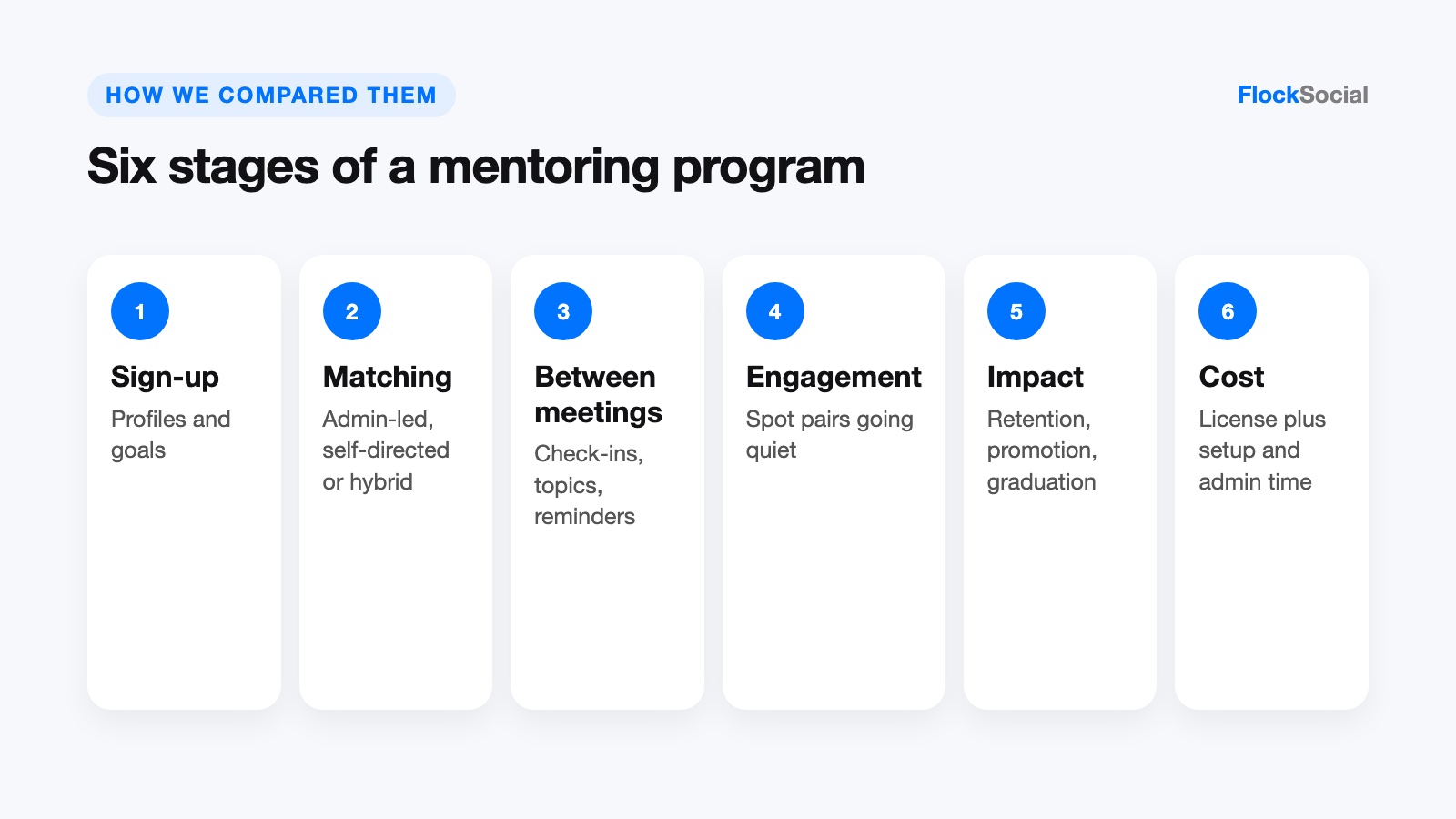
We looked at each platform across the same six stages of a program: sign-up, matching, the work between meetings, engagement tracking, impact reporting, and cost. For pricing, we used each vendor's own pricing page where it publishes numbers, checked in October 2026.
Where a vendor publishes no price, we say so and give the figure listed on a public software directory, naming the directory. Ratings come from Capterra or Software Advice and are named in each entry. Every entry gets the same fields and a real limitation. We did not run paid trials, so features are described as each vendor documents them.
The six mentoring platforms at a glance
| Platform | Best for | Matching approach | Impact reporting | Published pricing | Rating |
|---|---|---|---|---|---|
| MentorCity | Organizations that want matching, engagement and admin reporting in one place | Self-directed, admin-led, hybrid or competency-based | Customizable reports, program health and report card through AI Admin | Quote-based Standard and Enterprise plans | 4.7 on Capterra (34 reviews) |
| Mentorloop | Nonprofits and community groups starting a first program on a low-cost mentoring platform | Manual matching plus Smart Match recommendations | Live dashboard, PDF export reports, sentiment tracking | Pro plan from $299 per month | 4.69 on Software Advice (67 reviews) |
| PushFar | Organizations of 50 to 5,000+ people that want templates and fast setup | Rules-based, AI-assisted matching | Dashboards for engagement, skills and retention | Not on its own site; Capterra lists from $200 per month flat rate | 5.0 on Capterra (60 reviews) |
| Qooper | Mid-size and large companies that want a dedicated success manager | Configurable mentor matching | Analytics, engagement and progress data plus an ROI calculator | Custom; Software Advice lists from $10,000 per year | 4.79 on Software Advice (170 reviews) |
| Chronus | Large enterprises running many programs and employee resource groups | Configurable matching across program types | Reporting and insights, ROI calculators | Tiers by license count, price on request | 4.78 on Software Advice (158 reviews) |
| MentorcliQ | Enterprises that want a formal ROI dashboard and benchmarking | Proprietary Smart Matching algorithm | Real-time analytics; ROI dashboard on CliQ Plus | CliQ Start from $9,900 per year | 4.92 on Software Advice (201 reviews) |
The 6 mentoring platforms, ranked
1. MentorCity
Best for: HR teams, universities, alumni networks and associations that want one mentoring platform covering matching, the weeks between meetings and the admin reporting that proves impact.
MentorCity is cloud-based mentoring software that connects mentees with mentors and guides each pair through the relationship. Program owners pick how matching works for each program: self-directed (mentees browse and request), admin-led, a hybrid, or competency-based matching that pairs people on skills rather than job titles. Matching decisions stay with participants and administrators.
What sets it apart in this list is how much happens after the match. When a pair signs a mentoring agreement and sets the program length, the platform sends pulse surveys, monthly discussion topics, and evaluation requests on its own schedule, so the manager is not chasing people by email. Lexa, the AI mentor, helps participants prepare for a meeting and reflect afterward, and AI notetaking runs inside the built-in video calls.
AI Admin, launched in 2026, gives program managers an overview of program health, an engagement report for community discussions, and a program report card. It can also draft personalized messages to participants, which the admin reviews and sends with one click (it never sends anything on its own). The design idea is simple. AI does the prep work, and people keep the judgment, the decisions, and the conversations.
There is published proof that this mentoring platform cuts admin work. CPLED, which runs a legal practice readiness program, cut admin time from about 700 hours per intake to about 50 and saw no-shows drop from 12% to 1.46%.
- Key features: four matching models, mentoring agreements with automated surveys, in-platform video with AI notetaking, Lexa AI mentor, AI Admin program report card, goals, courses, group mentoring, iOS and Android app
- Rating: 4.7 out of 5 on Capterra (34 reviews)
- Pricing: two quote-based plans, Standard and Enterprise, with licensing based on active participants
Not good for: buyers who want a price list before the first call, since neither plan has a published price, and teams that need single sign-on on the base plan, because SSO and custom integrations sit in the Enterprise plan. It also does not use AI to auto-assign pairs, so very large one-round matching needs an administrator in the loop.
2. Mentorloop
Best for: nonprofits, community groups and smaller teams launching their first mentoring program on a known monthly budget.
Mentorloop is mentoring software with one of the clearest public price points in the category. You can build a program for free before paying, and the Pro plan is designed, in Mentorloop's own words, with nonprofits and community groups in mind. Every plan includes unlimited matches, goal setting, video and chat, calendar integration and a live dashboard.
On the impact side, it is stronger than its price suggests. Live sentiment tracking gives managers a running read of how participants feel, and PDF export reports and monthly digests cover the board-report side. An Admin Time Tool estimates how many hours the program saves.
- Key features: manual matching plus Smart Match recommendations, sentiment tracking, live program dashboard, Mentorloop Milestones, help hub
- Rating: 4.69 out of 5 on Software Advice (67 reviews)
- Pricing: Pro plan starting from $299 per month; Enterprise by quote; charities are pointed to a Community Support Program
Not good for: programs that need fully custom sign-up forms and matching profiles on the entry plan. On Pro these follow preset program themes, and full customization, SSO and integrations are Enterprise features.
3. PushFar
Best for: organizations of roughly 50 to 5,000 people that want ready-made program templates and fast setup.
PushFar is a mentoring platform for career progression, used by companies, educational institutions, and professional bodies. It supports mentoring, coaching, buddying and sponsorship programs from one account. Ready-made templates for leadership, diversity and onboarding programs shorten setup, and gamification nudges participation.
For measuring impact, PushFar offers dashboards that track engagement, skills and retention, with real-time reporting across relationships. Enterprise buyers get SAML single sign-on, role-based access, GDPR controls, HRIS and LMS integrations and white-label branding.
- Key features: smart, rules-based matching, program templates, gamification, impact dashboards, white-label branding
- Rating: 5.0 out of 5 on Capterra (60 reviews)
- Pricing: no prices on PushFar's own site; Capterra lists a starting price of $200 per month, flat rate
Not good for: buyers who want to confirm cost from the vendor's own pages. The public site shows only a demo request, so the directory figure needs to be checked against a written quote.
4. Qooper
Best for: mid-size and large companies that want a dedicated customer success manager guiding program design.
Qooper is enterprise mentoring software that bundles mentoring, training, and learning tools in one platform. Each customer gets program design templates and a dedicated success manager. The integration list is long for this category: CSV upload, SSO, Outlook and Google Workspace, Slack and Teams, HRIS, LMS, and database connections.
Reporting covers analytics, engagement, and progress data, and Qooper offers an ROI calculator to estimate returns.
Relationship progress and feedback are visible to admins across the program.
- Key features: configurable matching, program templates, learning tools inside the platform, broad integration list, cross-platform access
- Rating: 4.79 out of 5 on Software Advice (170 reviews)
- Pricing: custom, based on program scope and participant volume; Software Advice lists a starting price of $10,000 per year
Not good for: small programs or single departments. A starting point near $10,000 a year is a lot for a pilot of a few dozen pairs.
5. Chronus
Best for: large enterprises running many mentoring programs alongside employee resource groups and communities.
Chronus is mentoring software built for big organizations. Its plans bundle career development programs (onboarding, high-potential mentoring, reverse mentoring, learning circles, and more) with change programs such as AI adoption. The top tier adds employee resource groups and communities of practice, which makes Chronus a fit when mentoring is one part of a wider culture program.
Reporting and insights are pitched as a way to prove program impact with data, and ROI calculators sit in the resource library.
- Key features: wide program library, configurable matching per program type, ERG and community tools, reporting and insights
- Rating: 4.78 out of 5 on Software Advice (158 reviews)
- Pricing: three tiers by license count (up to 300 licenses with one program, up to 1,000, and above 1,000); prices on request
Not good for: teams that want several programs on a modest budget. The entry tier covers one program, and community features are an add-on below the top tier.
6. MentorcliQ
Best for: enterprises that want a formal ROI dashboard and benchmark data to show leadership.
MentorcliQ is enterprise mentoring software built around a proprietary Smart Matching algorithm and guided program design. Every plan includes real-time analytics, a survey suite, HRIS and SSO integration, an AI mentoring assistant for participants and custom branding.
Its impact reporting is the most formal on this list, but it is tiered. The Advanced Program ROI Dashboard and custom reports arrive with CliQ Plus, and the RISE benchmarking report and annual executive review come with CliQ Complete.
- Key features: Smart Matching algorithm, guided program design, survey suite, AI mentoring assistant, ROI dashboard (CliQ Plus and above)
- Rating: 4.92 out of 5 on Software Advice (201 reviews)
- Pricing: CliQ starts at $9,900 per year for 100 employees; CliQ Plus and CliQ Complete by quote
Not good for: buyers who need the ROI dashboard on a starter budget, because the entry plan includes real-time analytics but not the advanced ROI dashboard.
How to choose mentoring software that can prove impact
Start with the report you will need to hand in at the end of the year, and work backward. If the dean, the board, or the CFO will ask about retention, you need a platform that tracks the activity that leads there (meetings held, goals set, surveys returned) without someone exporting spreadsheets at midnight.
Then check these points on every shortlisted mentoring program software:
- Matching that fits your culture. Large or informal programs usually do better with self-directed matching, because people commit more to a mentor they picked themselves. Formal leadership programs often need admin control. Ask if you can run both models in one account.
- Support between meetings. Most pairs do not fail at the match. They fade out in month two or three. Look for automatic check-ins, reminders, and an early warning when a pair goes quiet.
- Impact reports by plan tier. Several vendors keep their best reporting in a higher tier, so ask which plan includes the report you need.
- Total cost of ownership. Add setup fees, integration work, admin hours, and the plan you will need in year two, on top of the entry price.
- SIS and system integration. None of the six lists a named student information system connector on its pricing page. Universities should ask their IT teams whether student records will come in through single sign-on, an API or a CSV import.
- Discounts. Mentorloop points charities to a Community Support Program, and MentorCity describes affordable pricing designed with nonprofits in mind. No vendor here publishes an education discount, so ask during the quote.
- Open source versus paid. Open-source mentoring tools have no license fee, but your own IT team then owns hosting, security updates, and student data protection. For most campuses, that shifts cost rather than removing it.
Managers matter here too. LinkedIn's research found that only a small share of employees (15%) say their manager helped them build a career plan in the past six months, which is the gap a well-run mentoring program is meant to fill.
Frequently asked questions
Do mentoring platforms offer education or nonprofit discounts?
Some do, but few publish terms. Mentorloop directs charities and nonprofits to its Community Support Program, and MentorCity states that its pricing is designed with nonprofits in mind. None of the six publishes an education discount, so universities should ask for one in writing during the quote stage.
What should a mentoring program impact report include?
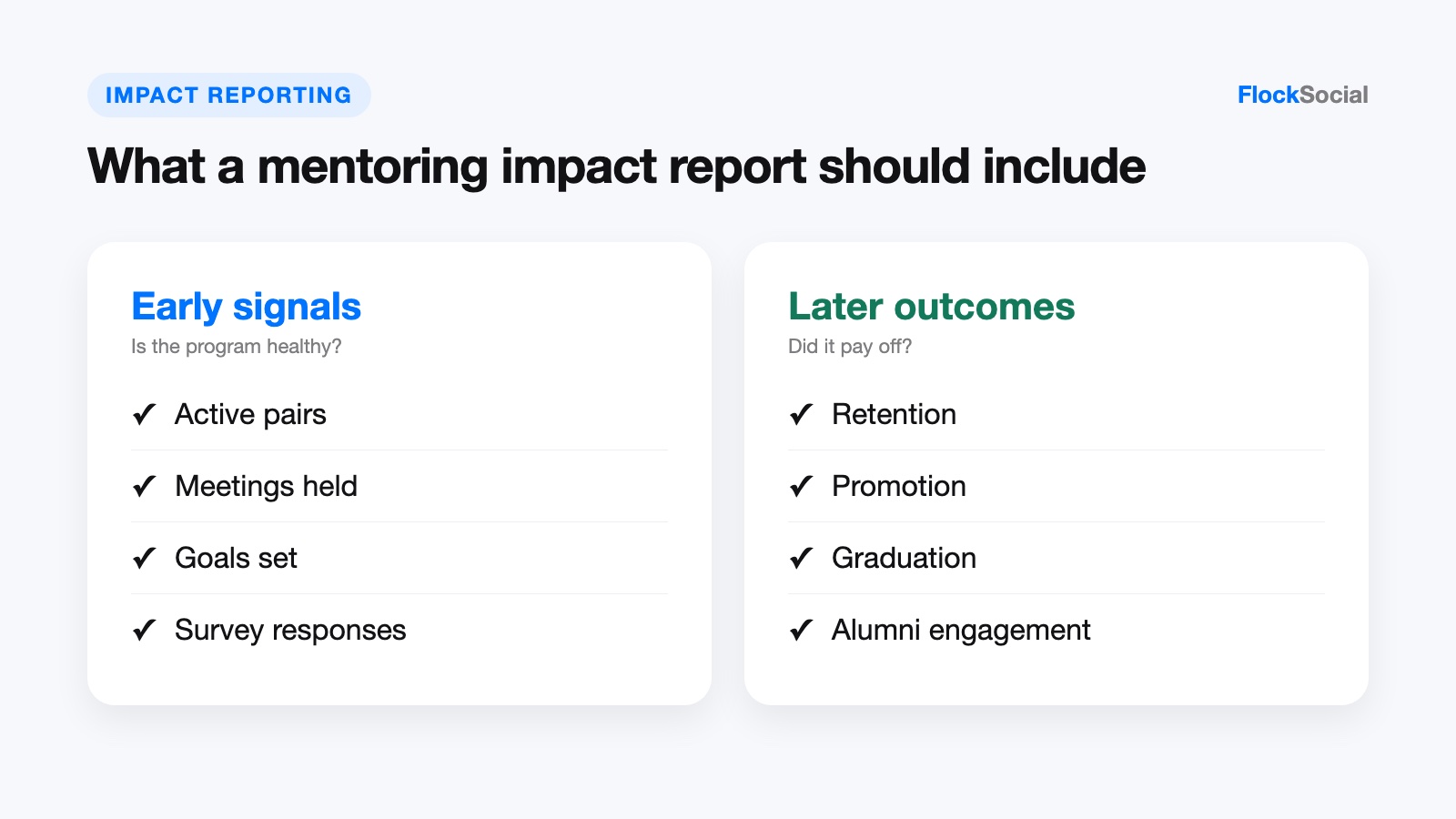
A useful report has two layers. Early signals show whether the program is healthy: active pairs, meetings held, goals set, and survey responses. Later outcomes show whether it paid off: retention, promotion, graduation, or alumni engagement. A report that only shows satisfaction scores will not survive a budget review.
Can mentoring software integrate with a student information system?
Usually through single sign-on, an API or a scheduled CSV import rather than a ready-made connector. Ask each vendor to show you the exact path student data takes, who maintains it, and where the data is hosted.
Is open-source mentoring software a good fit for a university?
It can be for a campus with a strong IT team and a small program. For most universities, the hosting, security patching, and data protection work cancels out the saved license fee.
The bottom line
Every platform here can match people. The real differences come in the weeks after the match and in the report at the end. MentorcliQ and Chronus suit large enterprises with big budgets, Qooper suits companies that want a hands-on success manager, and Mentorloop and PushFar give smaller teams a clearer entry price.
For HR teams, universities, and alumni networks that want mentoring software combining four matching models, automated check-ins through mentoring agreements, and an AI Admin program report card that keeps people in charge of every message, MentorCity offers its Standard and Enterprise plans on a quote basis, licensed by active participants.